By Helena Bottemiller
May 28, 2010
Environmental groups and the U.S. Environmental Protection Agency reached a settlement yesterday requiring the agency to propose a rule on greater information gathering on factory farms, otherwise known as concentrated animal feeding operations (CAFOs). The rule, to be proposed within 12 months, would require the 20,000 or so domestic factory farms to report information like how they dispose of manure and other waste.
http://www.foodsafetynews.com/2010/05/epa-reaches-settlement-in-cafo-clean-water-act-case/
Saturday, May 29, 2010
Thursday, May 27, 2010
TakePart Post - Hazardous Fruits and Vegetables: Do You Know the Dirty Dozen?

By Megan Bedard
May 27, 2010
"Rules for food shopping seem to multiply daily, and navigating the supermarket has become a fact-frenzy nightmare. When is the right season to buy a potato? Which fish is sustainable, again? Is the recall on lettuce over?..."
See full post here for more resources such as iPhone apps for foodies and the full version of the produce shopping cheat sheet pictured above.
Wednesday, May 26, 2010
Washington Post Article - Nutrition buzzwords make hay out of grains of truth
By Melissa Bell
Thursday, May 27, 2010
"Because of rising obesity rates and a push for more healthy living, many new products in the supermarket claim to be low-fat, immunity-boosting, vitamin-added foods. Some brands have become more healthful. But many manufacturers are promoting a product's healthful ingredients while playing down its less nutritional qualities. It is a food label sleight-of-hand that Bruce Silverglade of the Center for Science in the Public Interest, a nonprofit advocacy group, calls a "rip-off" for consumers..."
See full article, along with cheat sheet to the marketing words and phrases found in supermarket foods (such as "natural" or "a source of"), here.
Thursday, May 27, 2010
"Because of rising obesity rates and a push for more healthy living, many new products in the supermarket claim to be low-fat, immunity-boosting, vitamin-added foods. Some brands have become more healthful. But many manufacturers are promoting a product's healthful ingredients while playing down its less nutritional qualities. It is a food label sleight-of-hand that Bruce Silverglade of the Center for Science in the Public Interest, a nonprofit advocacy group, calls a "rip-off" for consumers..."
See full article, along with cheat sheet to the marketing words and phrases found in supermarket foods (such as "natural" or "a source of"), here.
Tuesday, May 25, 2010
Food Politics Post - The Slaughterhouse Problem: is a resolution in sight?
May 25, 2010
After years of hearing sad tales about the slaughterhouse problem, it looks like many people are trying to get it resolved. A fix no longer seems impossible. The slaughterhouse problem is what small, local meat producers have to contend with when their animals are ready to be killed. The USDA licenses so few slaughterhouses, and the rules for establishing them are so onerous, that humanely raised (if that is the correct term) animals have to be trucked hundreds of miles to considerably less humane commercial facilities to be killed. Furthermore, appointments for slaughter must be made many months or years in advance — whether the animals are ready or not.
http://www.foodpolitics.com/2010/05/the-slaughterhouse-problem-is-a-resolution-in-sight/
After years of hearing sad tales about the slaughterhouse problem, it looks like many people are trying to get it resolved. A fix no longer seems impossible. The slaughterhouse problem is what small, local meat producers have to contend with when their animals are ready to be killed. The USDA licenses so few slaughterhouses, and the rules for establishing them are so onerous, that humanely raised (if that is the correct term) animals have to be trucked hundreds of miles to considerably less humane commercial facilities to be killed. Furthermore, appointments for slaughter must be made many months or years in advance — whether the animals are ready or not.
http://www.foodpolitics.com/2010/05/the-slaughterhouse-problem-is-a-resolution-in-sight/
Epicurious - 10 Delicious Veggie Recipes
By Joanne Camas
May 24, 2010
In honor of Britain's National Vegetarian Week and the ongoing U.S. Meatless Monday campaign, here are some top-rated veggie recipes to enjoy:
• Spicy Tomato, Pepper, Cucumber, Mint, and Parsley Salad
• Farmer's Market Salad with Aged Gouda and Roasted Portabellas
• Smoky Corn Salsa
• Ratatouille
• African Curried Coconut Soup with Chickpeas
• Vegetarian Black Bean Chili
• Artichoke Ravioli with Tomatoes
• Double-Dutch Mac and Cheese with Chard
• Farmstand Gazpacho
• Individual Zucchini, Lemon, and Ricotta Galettes
May 24, 2010
In honor of Britain's National Vegetarian Week and the ongoing U.S. Meatless Monday campaign, here are some top-rated veggie recipes to enjoy:
• Spicy Tomato, Pepper, Cucumber, Mint, and Parsley Salad
• Farmer's Market Salad with Aged Gouda and Roasted Portabellas
• Smoky Corn Salsa
• Ratatouille
• African Curried Coconut Soup with Chickpeas
• Vegetarian Black Bean Chili
• Artichoke Ravioli with Tomatoes
• Double-Dutch Mac and Cheese with Chard
• Farmstand Gazpacho
• Individual Zucchini, Lemon, and Ricotta Galettes
Atlantic Article - The 'Veggie' Option: As Bad as Mystery Meat
By Helene York
May 24, 2010
Too often the vegetarian or "veggie" option in our food culture is defined as the "absence of meat"—especially for lunch. Shredded lettuce, tomato slices, and a slice of Swiss between two pieces of bread is wanting for most vegetarians and is downright laughable to meat eaters. It's an option characterized by the omission of an ingredient, not a celebration of what's inside.
http://www.theatlantic.com/food/archive/2010/05/the-veggie-option-as-bad-as-mystery-meat/57036/
May 24, 2010
Too often the vegetarian or "veggie" option in our food culture is defined as the "absence of meat"—especially for lunch. Shredded lettuce, tomato slices, and a slice of Swiss between two pieces of bread is wanting for most vegetarians and is downright laughable to meat eaters. It's an option characterized by the omission of an ingredient, not a celebration of what's inside.
http://www.theatlantic.com/food/archive/2010/05/the-veggie-option-as-bad-as-mystery-meat/57036/
Huffington Post Article - Meatless Monday: The Protein Principle
By Chris Elam
Posted: May 24, 2010
Wow, the numbers are startling. Americans consume an astonishing amount of protein. USDA statistics reveal that U.S. men eat as much as 190% of their recommended daily protein allowance, while women eat as much as 160%, the great majority of which comes from saturated-fat heavy meat and meat products. Protein is essential to life; it builds and maintains muscles, bones and skin, and regulates metabolism and digestion. But the question remains, whether you look at it from the perspective of personal health, or environmental degradation, or cost savings, or animal rights, or veggie activism, or whatever else floats your boat: do we really need to eat all that meat?
See rest of article here, along with low-fat vegetarian food combos and recipes from the Meatless Monday movement.
Posted: May 24, 2010
Wow, the numbers are startling. Americans consume an astonishing amount of protein. USDA statistics reveal that U.S. men eat as much as 190% of their recommended daily protein allowance, while women eat as much as 160%, the great majority of which comes from saturated-fat heavy meat and meat products. Protein is essential to life; it builds and maintains muscles, bones and skin, and regulates metabolism and digestion. But the question remains, whether you look at it from the perspective of personal health, or environmental degradation, or cost savings, or animal rights, or veggie activism, or whatever else floats your boat: do we really need to eat all that meat?
See rest of article here, along with low-fat vegetarian food combos and recipes from the Meatless Monday movement.
Saturday, May 22, 2010
New York Review of Books - The Food Movement, Rising
"In what is ostensibly a five-book review (see book list below) for the June 10 New York Review of Books, journalist Michael Pollan has an epic essay charting the emergence and character of the food movement. Or, as he puts it, "'movements,' since it is unified as yet by little more than the recognition that industrial food production is in need of reform because its social/environmental/public health/animal welfare/gastronomic costs are too high." (Pollan, of course, has been indispensable in the rise of this movement, yet he omits his 2006 best-seller, The Omnivore's Dilemma, from his list of its catalysts -- among them Eric Schlosser's Fast Food Nation, Marion Nestle's Food Politics.)" (quoted from The Ethicurean)
• Everything I Want to Do Is Illegal: War Stories from the Local Food Front by Joel Salatin
• All You Can Eat: How Hungry Is America? by Joel Ber
• Eating Animals by Jonathan Safran Foer
• Terra Madre: Forging a New Global Network of Sustainable Food Communities by Carlo Petrini, with a foreword by Alice Waters
• The Taste for Civilization: Food, Politics, and Civil Society by Janet A. Flammang
See Michael Pollan's full essay, "The Food Movement, Rising," here.
• Everything I Want to Do Is Illegal: War Stories from the Local Food Front by Joel Salatin
• All You Can Eat: How Hungry Is America? by Joel Ber
• Eating Animals by Jonathan Safran Foer
• Terra Madre: Forging a New Global Network of Sustainable Food Communities by Carlo Petrini, with a foreword by Alice Waters
• The Taste for Civilization: Food, Politics, and Civil Society by Janet A. Flammang
See Michael Pollan's full essay, "The Food Movement, Rising," here.
Huffington Post Article - Chicken Farmers Describe a System of Extortion and Economic Slavery
By Regina Weiss
May 21, 2010

Today, poultry growers from throughout the south told Attorney General Eric Holder that the US poultry business operates through price fixing and production controls that stifle fair competition and destroy the lives of family farmers. According to the growers, who spoke at a hearing in Normal, Alabama, they are trapped in an unsustainable system that leaves them with skyrocketing costs, poverty wages and zero job security. As one grower put it, "This system takes hard working farmers and makes them indentured servants on their own land."
http://www.huffingtonpost.com/regina-weiss/chicken-farmers-describe_b_585459.html
May 21, 2010
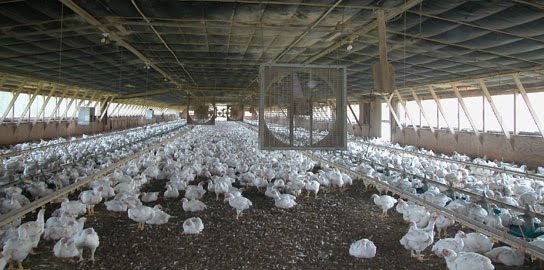
Today, poultry growers from throughout the south told Attorney General Eric Holder that the US poultry business operates through price fixing and production controls that stifle fair competition and destroy the lives of family farmers. According to the growers, who spoke at a hearing in Normal, Alabama, they are trapped in an unsustainable system that leaves them with skyrocketing costs, poverty wages and zero job security. As one grower put it, "This system takes hard working farmers and makes them indentured servants on their own land."
http://www.huffingtonpost.com/regina-weiss/chicken-farmers-describe_b_585459.html
Friday, May 21, 2010
TakePart Post - Why Animal Antibiotics Can Make You Sick-And Keep You Sick
By Megan Bedard
May 20, 2010
It probably makes your stomach turn to hear that you could be unknowingly ingesting antibiotics that are used to treat cows. Well, swallowing all those antibiotics is making other parts of your body do a 180 as well. A new study released by scientists at the University of Hong Kong suggests that the overuse of antibiotics in the food industry is causing resistance among humans to certain antibiotics. In short: when farmers stuff cows with antibiotics, the cows develop resistance genes, then pass them along to us.
http://www.takepart.com/news/2010/05/19/more-factory-farms-mean-more-illness
May 20, 2010
It probably makes your stomach turn to hear that you could be unknowingly ingesting antibiotics that are used to treat cows. Well, swallowing all those antibiotics is making other parts of your body do a 180 as well. A new study released by scientists at the University of Hong Kong suggests that the overuse of antibiotics in the food industry is causing resistance among humans to certain antibiotics. In short: when farmers stuff cows with antibiotics, the cows develop resistance genes, then pass them along to us.
http://www.takepart.com/news/2010/05/19/more-factory-farms-mean-more-illness
Subscribe to:
Posts (Atom)


 Posts
Posts

